Arm Lift After Weight Loss: When Liposuction Alone Is No Longer Enough
Major weight loss can transform the size and proportions of the body, but the skin does not always contract to match the new volume underneath it.
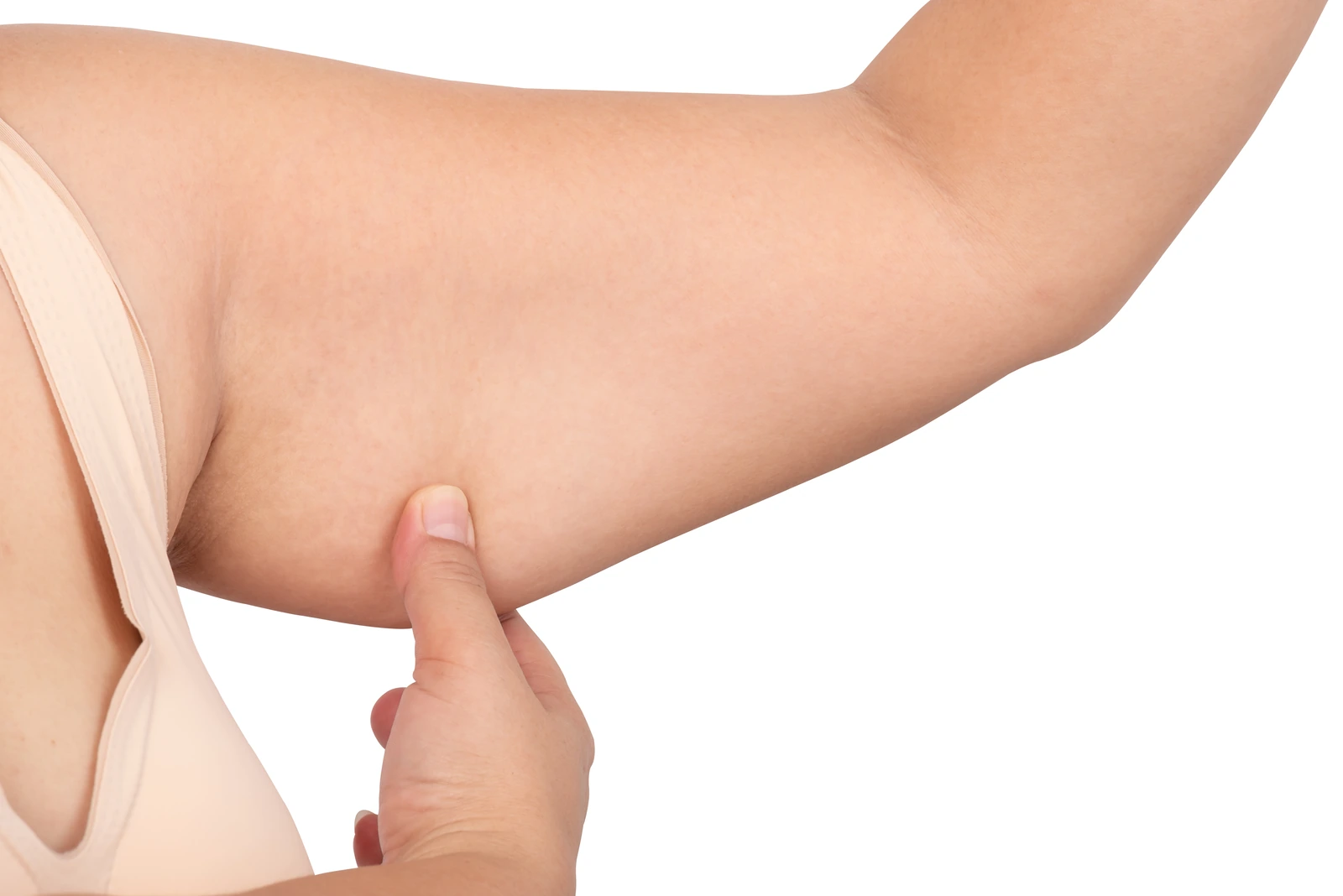
The upper arms are one of the areas where this discrepancy can be particularly noticeable. A person may have lost a substantial amount of fat yet still have a fold of loose skin extending from the armpit toward the elbow.
At that point, the question is no longer simply how to remove more fat. It becomes a question of what is creating the remaining contour: residual fat, excess skin, or both.
Why loose skin can remain after weight loss
Skin is capable of stretching and contracting, but that capacity has limits.
When the upper arms have carried greater volume for years, the skin and supporting tissues may have been significantly stretched. After weight loss, some contraction occurs, but the skin may not return completely to its previous dimensions.
The amount of residual laxity varies considerably. Age, genetics, the amount and speed of weight loss, previous weight fluctuations and skin quality can all influence what remains.
This is why continued weight loss or exercise does not necessarily eliminate hanging skin once a person has reached a relatively stable weight.
What can liposuction accomplish?
Liposuction is designed to reduce localized subcutaneous fat.
If the upper arm still contains a disproportionate layer of fat and the skin has sufficient elasticity, liposuction may improve its contour without removing skin.
The situation changes when the dominant issue is laxity.
Removing additional fat from underneath already loose skin does not make that skin disappear. In a patient with significant laxity, decreasing the underlying volume can sometimes make the skin excess more apparent.
This distinction is central to choosing between liposuction and an arm lift.
What does an arm lift address?
An arm lift, or brachioplasty, removes excess skin and reshapes the upper arm.
Depending on the amount and location of the laxity, the required incision can vary. More extensive skin excess generally requires a longer incision along the inner or posterior aspect of the upper arm.
That creates the fundamental trade-off of brachioplasty: a tighter contour is achieved by accepting a permanent scar.
For someone with substantial hanging skin, that exchange may be worthwhile. For someone with only mild laxity, it may not be.
Sometimes the problem is both skin and fat
Post-weight-loss arms do not always fit neatly into one category.
There may be loose skin together with pockets of residual fat. In selected situations, liposuction can therefore be incorporated into an arm lift to help address volume while the brachioplasty deals with the excess skin.
The extent of either component depends on the anatomy rather than on a standardized formula.
The goal is not to make the arm as thin as possible. The contour needs to remain proportionate to the shoulder, forearm and overall body.
Why weight stability matters
Body contouring is generally easier to plan when major weight loss has already been completed and the weight is reasonably stable.
If substantial additional weight loss occurs after an arm lift, more laxity may develop. Significant weight gain can also alter the contour.
For patients who have undergone bariatric surgery or a major lifestyle-related weight loss, timing therefore becomes part of the surgical discussion.
The scar deserves a serious conversation
Patients understandably focus on how much loose skin can be removed, but the location and length of the scar are equally important.
A meaningful reduction in extensive upper-arm skin cannot usually be achieved through an invisible incision.
Scars typically evolve over many months. Their final appearance varies with individual healing characteristics and other factors.
Looking at brachioplasty as an exchange — less redundant skin in return for a surgical scar — provides a more useful framework for deciding whether the procedure makes sense.
Arm lift surgery on Montréal’s South Shore
Patients from Longueuil, Brossard, Saint-Lambert, Boucherville, Saint-Bruno and surrounding South Shore communities may consider an arm lift when loose skin remains despite reaching a stable weight.
The key is identifying whether the remaining contour is caused primarily by fat, skin or a combination of both.
Dr Alain Gagnon can assess these components and discuss whether liposuction, brachioplasty or a combined approach may be appropriate.
If loose upper-arm skin remains after weight loss, a consultation in Longueuil can clarify which type of body contouring actually addresses it.
(514) 768-7906
550 chemin Chambly, Bureau 330, Longueuil, QC, J4H 3L8