
Inverted Nipples: Causes, Degrees of Inversion and When Surgery May Be Considered
An inverted nipple sits partly or completely below the surrounding areola instead of projecting outward.
For some people, this has been present since breast development and causes no physical problem. For others, inversion can interfere with cleaning, breastfeeding or comfort, or it may be an aesthetic concern.
The first question is not how to correct it. The first question is whether the inversion is longstanding or represents a new change.
Longstanding and newly acquired inversion are not the same
Nipples can be inverted from birth or become more apparent during breast development. Short milk ducts, fibrous attachments and the structure beneath the nipple may all contribute.
A nipple that has always been inverted and remains stable presents a different situation from one that retracts unexpectedly later in life.
New inversion—particularly on one side—should receive a medical assessment. This is especially important if it appears with a breast lump, skin changes, discharge or bleeding.
These symptoms do not establish a diagnosis by themselves, but an aesthetic consultation should not substitute for appropriate breast evaluation.
Inversion exists along a spectrum
Not every inverted nipple behaves in the same way.
A mildly inverted nipple may project with cold, stimulation or gentle pressure and remain outward for a period. A more persistent inversion may be brought outward but retract again. In a more severe case, the nipple may be difficult to evert manually.
Surgeons sometimes describe this spectrum using grades. The classification helps communicate how easily the nipple can be brought forward and how likely it is to remain there.
It is not intended as a self-diagnosis. The underlying attachments and the importance of preserving milk ducts must also be considered.
Does every inverted nipple need treatment?
No. A stable inverted nipple that causes no functional or personal concern does not automatically require correction.
Some people consider treatment because the fold is difficult to clean or repeatedly irritated. Others experience difficulty with breastfeeding, although nipple shape is only one of many factors that can affect feeding. Aesthetic preference and self-consciousness can also be valid reasons to request information.
The decision should remain personal. Normal variation in nipple appearance does not need to be medicalized simply because it differs from an idealized image.
Why surgical techniques differ
Correction generally involves releasing or rearranging the tissues that hold the nipple inward and supporting its new projection.
The necessary release depends on severity. In some cases, a duct-preserving approach may be possible. More severe or fibrotic inversion may require a different balance between reliable release and preservation of the structures beneath the nipple.
Because techniques vary, it would be misleading to promise one incision or method before examining the nipple. The risk of recurrent inversion also depends partly on the original anatomy and the correction performed.
Breastfeeding belongs in the discussion
Milk ducts travel toward openings in the nipple. A technique that divides or substantially disrupts these ducts can affect the ability to breastfeed from that breast.
Duct-preserving surgery may be discussed when future breastfeeding is important, but preservation does not guarantee that breastfeeding will be possible. The original inversion itself, milk production, infant factors and other breast conditions can also influence feeding.
Patients who may want to breastfeed in the future should raise this priority explicitly during consultation. It can materially affect the choice of technique and whether surgery should be postponed.
Sensation and projection can change
The nipple-areola complex contains small nerves as well as ducts and supporting tissues.
Temporary changes in sensation can occur after surgery, and permanent change is also a possible risk. Projection may soften as tissues heal, and some nipples can partially or completely invert again.
Other considerations include bleeding, infection, wound-healing problems, asymmetry and scarring. An informed decision weighs these possibilities against the functional or aesthetic concern prompting treatment.
What should be assessed before correction?
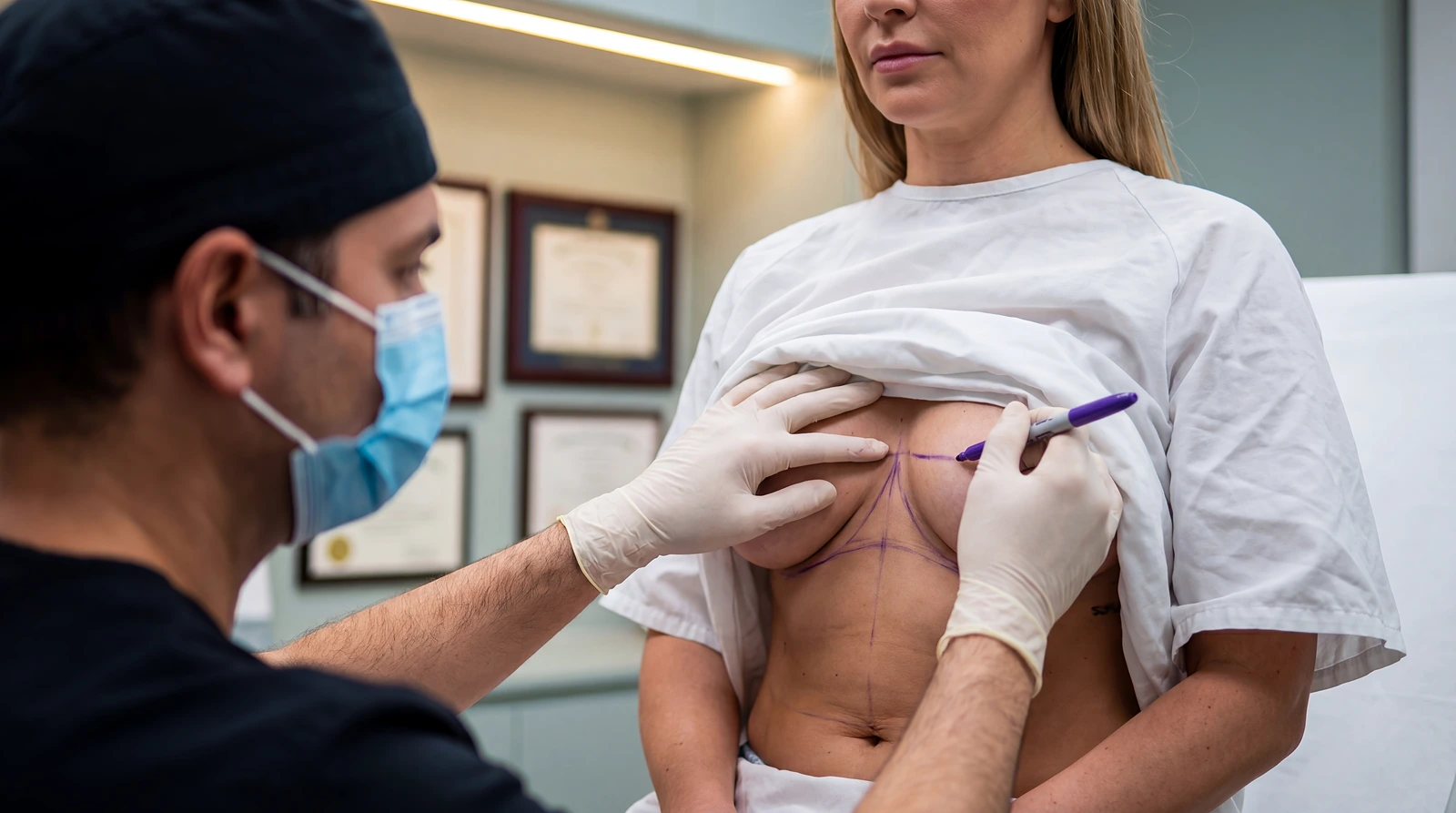
A consultation should document when the inversion began, whether it affects one or both breasts and whether it changes with stimulation or gentle traction.
Relevant questions include previous breastfeeding, pregnancy plans, breast operations, infections, discharge and other new breast symptoms. The examination also considers asymmetry and the amount of available nipple tissue.
If the history or examination raises concern about an acquired breast change, diagnostic assessment takes priority over cosmetic correction.
Inverted nipple correction in Longueuil
Dr Alain Gagnon offers consultations for inverted nipple correction in Longueuil and Montréal’s South Shore.
The assessment can distinguish the degree of inversion, discuss whether correction is appropriate and explain how breastfeeding priorities, sensation, scars and recurrence affect the choice.
If a nipple has recently become inverted, seek a medical breast assessment. For a stable, longstanding concern, request a consultation to discuss correction and its limitations.
(514) 768-7906
550 chemin Chambly, Bureau 330, Longueuil, QC, J4H 3L8